It starts as a faint itch on the earlobe after a long day. A week later the skin under a favorite ring is red and rough, and the pretty chain you wear to work leaves a pink line on your neck. The jewelry has not changed. Your skin has, and the label on the box rarely tells you why.
In most cases the reason is one metal: nickel. The good news is that a few materials are reliably kind to sensitive skin, and a few label words tell you almost nothing. Here is which metals to trust, which words to question, how the EU and US rules differ and how to check the pieces you already own.
The short answer.
Calmest choice
Titanium
Implant-grade titanium is what professional piercers recommend for people worried about nickel. Light, strong, everyday-proof.
Investment
Platinum
Extremely inert. Ask what the other 5 percent is if you also react to cobalt.
Classic
Solid gold, 14K and up
Nickel-free yellow gold alloys suit most skin. White gold and 9K need a closer look.
Budget everyday
316L steel
Contains nickel but releases very little of it. Generic "stainless" is not the same thing.
Be careful with plated base metal, nickel white gold, 9 karat gold and anything sold only as "hypoallergenic". The dots above summarize what the sources below say about nickel; how your own skin reacts is personal, and a patch test is the only way to know for sure.
In this guide
01 / The culprit
Why jewelry makes skin itch.
Nickel allergy is one of the most common causes of allergic contact dermatitis. According to DermNet's guide to jewelry allergies, most jewelry allergy comes from nickel and, less often, cobalt, and many people who think they are allergic to gold or silver are really reacting to nickel hidden in the alloy or in the base metal under a plating.
The rash shows up where metal meets skin: earlobes, fingers, the neck and the wrist. It is intensely itchy and can be red and blistered, or dry, thickened and darker with long-term contact. Mayo Clinic dermatologists note it can appear hours or days after you put the piece on. Once the allergy has developed it usually lasts for years, often for life, and some people only react after many years of wearing the same metal without trouble.
14.5%
Of European adults were allergic to nickel in the EDEN patch-test study
22%
Of women, compared with 5.3% of men
20.8%
Of people with past piercings, against 6.4% never pierced
Those figures come from the EDEN study of metal allergy in Europe, which patch tested a random sample of 3,119 adults aged 18 to 74 in five European countries. The piercing gap is the striking part: skin that has had metal pushed through it is far more likely to be sensitized.
Not every red mark is an allergy
Friction, soap or lotion trapped under a ring, and dirt on the metal can irritate skin without any allergy involved, especially if you have eczema or sensitive skin. A fresh piercing that oozes and crusts may be infected. And the green stain some rings leave is usually copper reacting with sweat: a dermatologist at Nebraska Medicine explains it is harmless and washes off with soap and water.
02 / The detail that matters
Nickel content is not the whole story.
What triggers a reaction is not how much nickel sits inside a metal, but how much of it comes out onto your skin when sweat sits on it. That is why rules and tests measure nickel release in micrograms per square centimeter per week, and why some metals that contain nickel are still gentle.
316L stainless steel is the best example. It contains roughly 10 to 12 percent nickel, yet in lab tests with acidic artificial sweat, low-sulfur grades such as 316L released less than 0.03 micrograms per square centimeter per week and did not cause reactions in people already allergic to nickel. A free-machining grade, 303, released about 1.5, and nickel-plated samples around 100.
~200×
Nickel-plated metal vs the EU limit (our calculation)
~3×
Grade 303 steel vs the limit
<1/16
Low-sulfur 316L, a small fraction of the limit
Our calculation, using the EU limit of 0.5 µg/cm² per week for jewelry worn against the skin and the release figures from Haudrechy and colleagues, Contact Dermatitis 1997. A 2015 study of polished jewelry steels found the same pattern: 2.06 for grade 303, 1.51 for grade 201, 0.08 for 304 and 0.02 for 316L. In other words, "stainless steel" is a family, not a guarantee. Ask for the grade.
03 / Metal by metal
Metal by metal: what is safe.
Here is how the common jewelry metals line up for sensitive skin, from the calmest to the ones to watch. Sources sometimes draw the lines slightly differently, and where they do, we say so.
- Titanium The Association of Professional Piercers calls it ideal for people with nickel concerns. Look for implant-grade Ti6Al4V ELI (ASTM F136) or commercially pure titanium (ASTM F67). It can be anodized in colors without changing its safety.
- Niobium Very similar to titanium and used by piercers for years with good results, though it has no implant-grade designation. It anodizes into colors, including black.
- Platinum Extremely inert, according to the piercers' association. Jewelry platinum is usually 95 percent pure (stamped Pt950 or 950), and the rest can be ruthenium, iridium or cobalt. In one small study, 5 of 30 people allergic to cobalt reacted to a platinum-cobalt jewelry alloy, though far more mildly than to cobalt itself. If cobalt is your trigger, ask.
- Gold 14K+ Solid yellow gold in nickel-free alloys suits most sensitive skin. The experts set the line at different karats: DermNet says 12 karat and above should be safe, the American Academy of Dermatology lists 18, 22 and 24 karat yellow gold, and professional piercers accept 14 karat for fresh piercings if it is nickel- and cadmium-free. The common thread is high karat and a nickel-free alloy.
- White gold Usually alloyed with nickel and then plated with rhodium for its bright white color. The plating protects you at first but wears off over months or years. Palladium white gold is the nickel-free alternative, at a higher price.
- 9K / 10K Nine karat gold is only 37.5 percent gold, and DermNet notes that it contains nickel. Low karats leave more room for other metals in the mix.
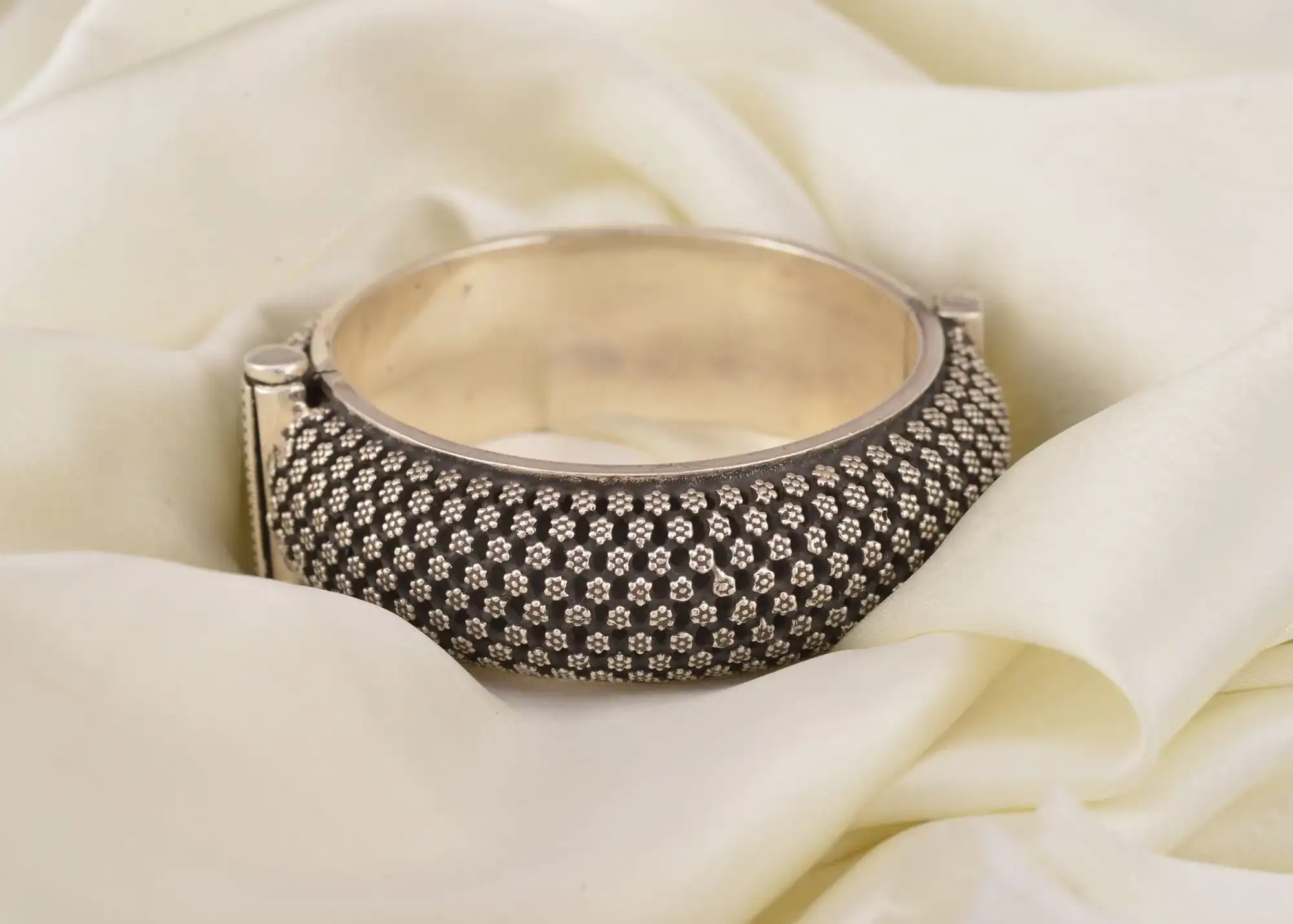
- 925 silver Sterling silver is 92.5 percent silver, usually alloyed with copper, and dermatology sources consider it generally safe, though traces of nickel are possible. Its tarnish and any green marks come from the copper, not from an allergy. Here is how to clean silver jewelry at home.
- 316L steel A good budget option, as long as it is really 316L. Avoid unnamed "stainless", free-machining grade 303 and anything nickel-plated.
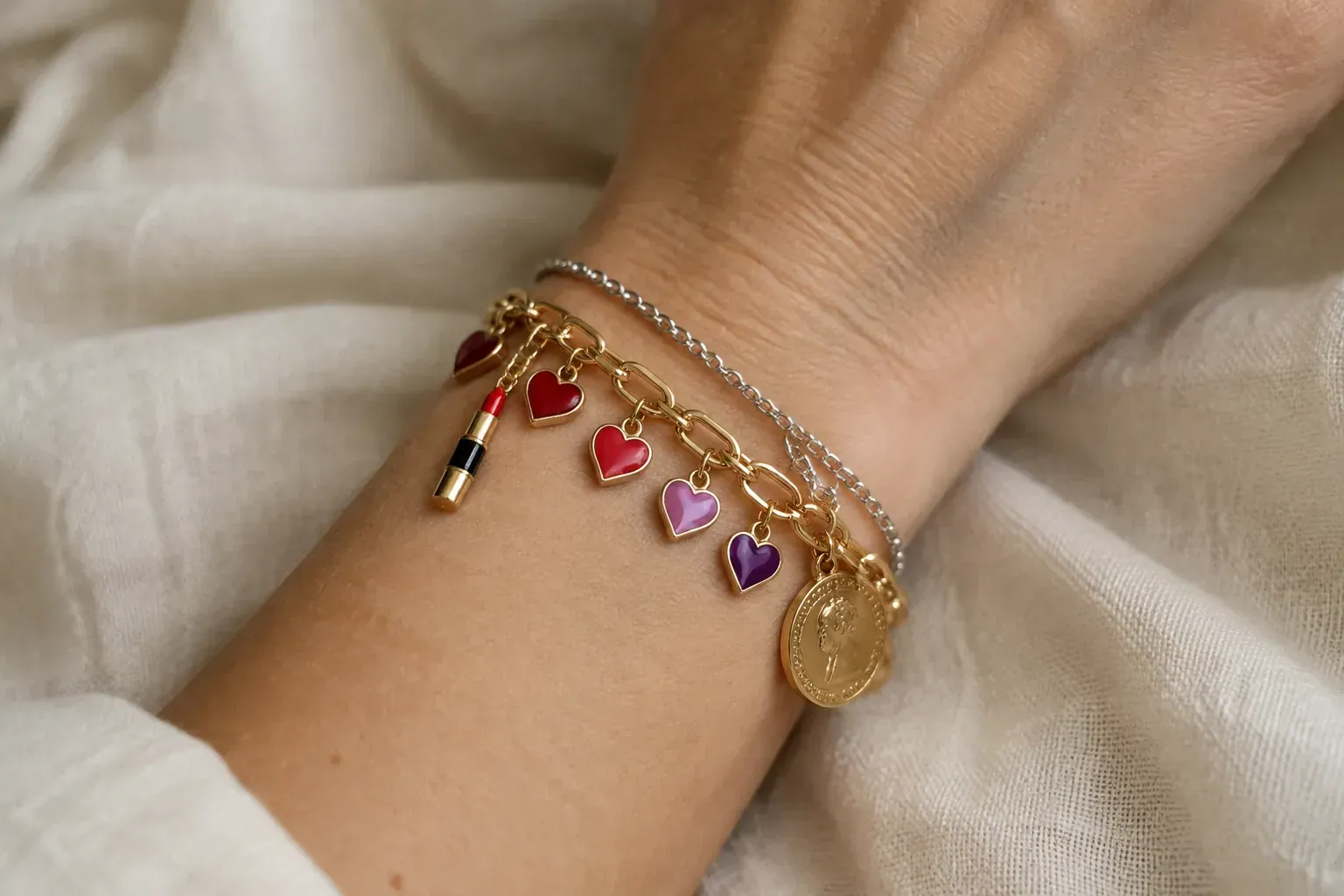
- Plated, vermeil, filled Only as safe as the core. The gold layer itself is rarely the trigger; trouble starts when it wears through. Vermeil has a sterling silver core, while plated and gold-filled pieces usually sit on brass or other base metal. Our guide to gold vermeil vs gold-filled vs gold-plated explains each one.
Our take
Placeholder for the owner's answer: which metal do you reach for when your skin is acting up, and is there one you have stopped buying altogether?
04 / Fresh piercings
New piercings play by stricter rules.
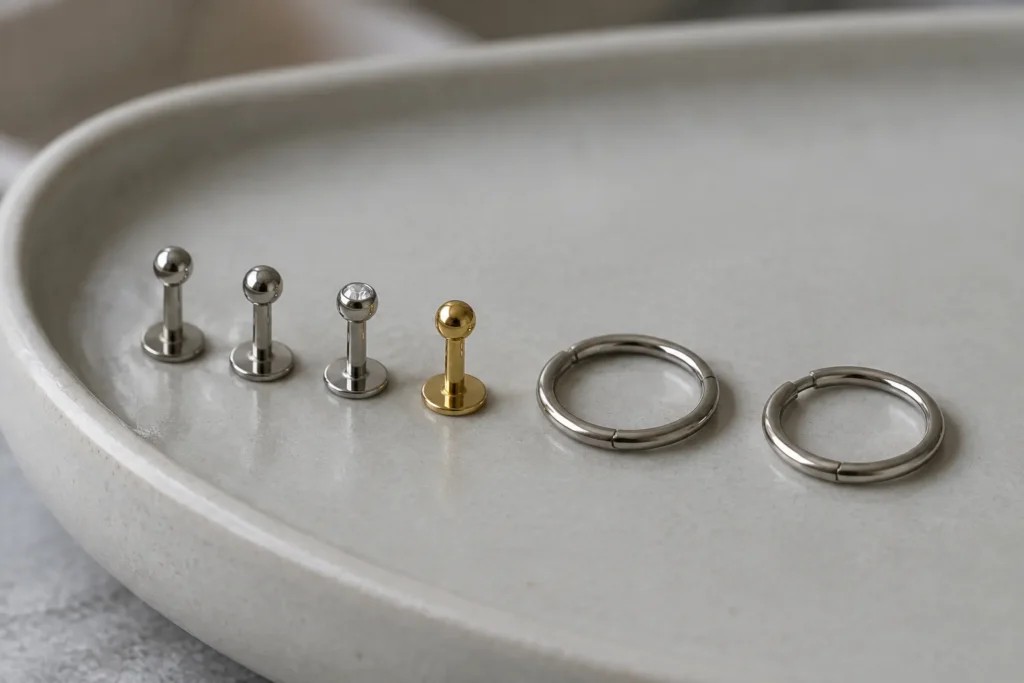
A new piercing is a wound with jewelry in it, so the standard is higher than for a ring on your finger. The Association of Professional Piercers accepts only a short list of materials for initial piercings:
- Steel that meets ASTM F138 or ISO 5832-1, the implant specifications, or that is proven compliant with the EU nickel rule.
- Titanium to ASTM F136, ASTM F1295 or ISO 5832-3, or commercially pure titanium to ASTM F67.
- Niobium.
- Solid gold of 14 karat or higher that is nickel- and cadmium-free. Above 18 karat it is too soft for body jewelry.
- Platinum.
- Glass: fused quartz, lead-free borosilicate or lead-free soda-lime.
Gold-plated, gold-filled and vermeil jewelry are not acceptable for fresh piercings, because the thin gold surface can wear or chip off. A good piercer can show you mill certificates, the documents from the metal supplier that state the grade.
05 / The small print
Words that sound safe but are not.
- Hypoallergenic There is no legal or scientific definition of the word for jewelry in the US, so any brand can use it. Treat it as a promise to ask about, not proof.
- Nickel-free Often means the piece meets the EU nickel-release limit rather than containing zero nickel. Ask whether it was tested to EN 1811, the EU test method.
- Surgical steel A family of alloys, not one grade. Piercers point out that only a few specific grades are proven biocompatible. Ask for 316L or ASTM F138.
- Gold tone A color, not a metal. Without a karat, assume plating over base metal.
- Platinum plated A thin layer that will wear, like any plating. Ask what lies beneath.
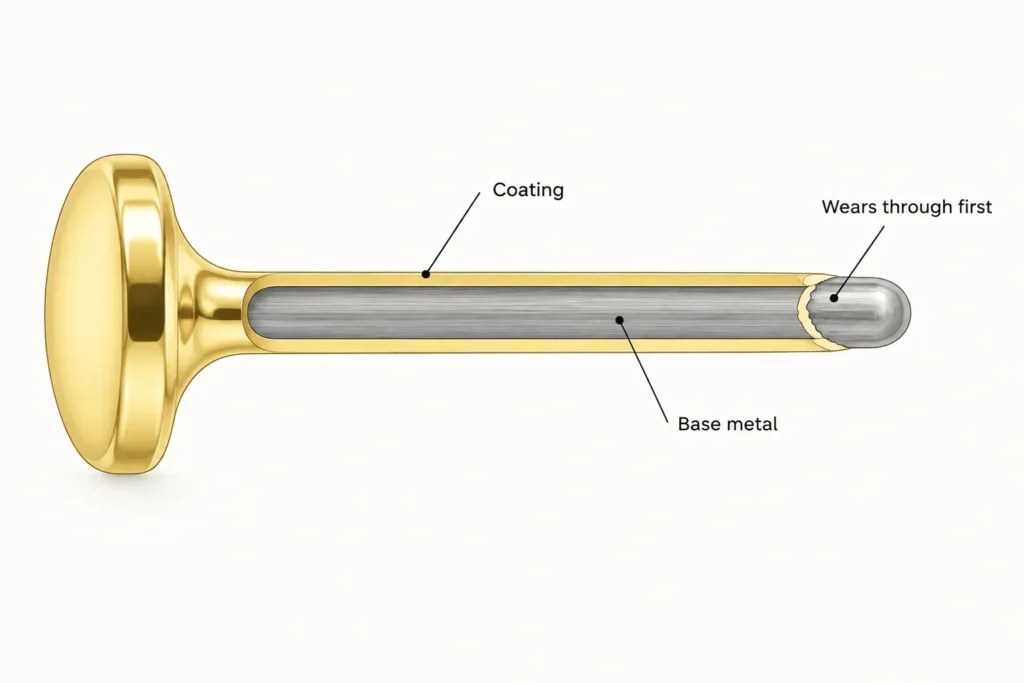
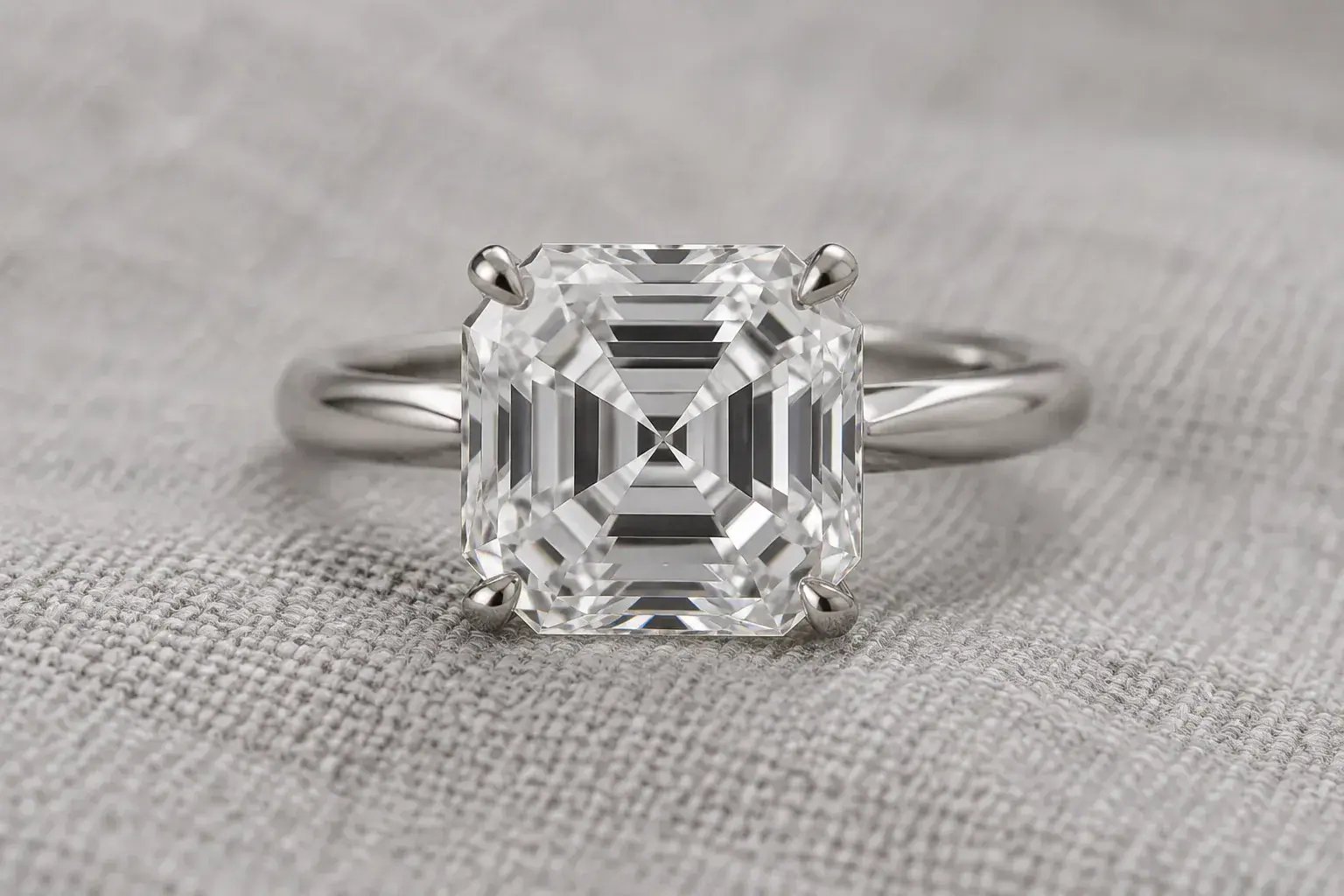
Plating is the reason many pieces feel fine for months and then suddenly do not. Rhodium on white gold, gold on brass and silver on base metal all wear thinnest where the jewelry rubs most: the inside of a ring band, the tip of an earring post, the clasp of a chain. The same applies to engagement ring settings, whether they hold a round or an Asscher cut diamond. Once the base metal shows through, it touches your skin every day.
06 / The rules
The EU rule, and the US gap.
In the European Union, nickel in jewelry has been regulated since the 1994 Nickel Directive, now part of the REACH regulation (Annex XVII, entry 27, the EU nickel restriction). It sets three limits:
0.2 µg
Nickel per cm² per week, maximum, for posts inserted into piercings
0.5 µg
Per cm² per week for earrings, necklaces, rings and other items worn against the skin
2 years
Coated pieces must stay under the limit for at least two years of normal use
Release is measured with the EN 1811 test, which soaks the piece in artificial sweat for a week, and coated items are first put through a simulated wear test, EN 12472. ECHA, the EU chemicals agency, has proposed defining "prolonged contact" as skin contact of more than 10 minutes on three or more occasions within two weeks, or more than 30 minutes once in two weeks. In practice, that covers almost every piece of jewelry you would actually wear.
The United States has no federal limit on nickel release from jewelry like the EU's. The ASTM F2999 consumer safety specification for adult jewelry, reapproved in 2026, points to the European test methods for nickel, and some states regulate certain metals in adult jewelry. For shoppers, that means a European compliance claim is a useful sign, and a vague "hypoallergenic" on its own is not.
Good to know
Even an EU-compliant piece is not guaranteed to be reaction-free. The limits are set to protect most people, but someone who is already strongly sensitized can still react to very small amounts.
07 / At home
How to check what you already own.
- Read the stamp. Look for 925 (sterling), 14K or 585, 18K or 750, Pt950, or a titanium mark. No stamp on a gold-colored piece usually means plating.
- Use a nickel spot test. Pharmacies and online shops sell kits with dimethylglyoxime. Rub a drop on the metal with a cotton bud: if it turns pink, nickel is coming off. DermNet notes the chemicals will not harm jewelry.
- Do not over-trust a clear result. In one lab comparison, 3 of 10 metal samples tested negative with the spot test yet still released considerable nickel. A pink result is a clear no; a clear result is a good sign, not a guarantee.
- Retest plated favorites. A ring that passed last year may fail once its plating wears thin, especially on the inside of the band.
- Try a barrier, briefly. Plastic covers for earring posts work. Clear nail polish is a short-term fix at best: Mayo Clinic says it may help but needs reapplying often, and DermNet does not recommend it for studs because it chips off quickly.
Our take
Placeholder for the owner's answer: what is your personal rule for buying plated or vermeil pieces if your skin is sensitive, and how do you wear them?
Five questions to ask before you buy.
- What exactly is the metal? A grade (316L, ASTM F136) or a karat (14K, 18K), not a word like "premium".
- Is the alloy nickel-free, or does it just meet the EU release limit? Both are fine for many people; the first is safer if you react strongly.
- For white gold: nickel or palladium? And is it rhodium-plated?
- For plated pieces: what is the core? Sterling silver, steel or brass behave very differently once the surface wears.
- What happens if I react? A brand confident in its materials will usually say so in its return policy.
Read the metal, not the marketing. A grade or a karat tells you something; "hypoallergenic" on its own tells you very little.
When to see a doctor
If a rash blisters, looks infected, spreads or keeps coming back, see a doctor or a board-certified dermatologist, as the American Academy of Dermatology advises in its guide to avoiding nickel exposure. A patch test can confirm which metals you react to, and a doctor can treat the rash itself. This guide is general information, not medical advice.
Questions, answered.
Can you suddenly become allergic to jewelry you have worn for years?
Yes. DermNet notes that some people react after brief contact, while others break out only after many years of wearing the same nickel-containing pieces. Plating that has worn thin can also expose base metal that was covered before.
Is sterling silver safe for sensitive ears?
For most people, yes. Sterling silver is 92.5 percent silver, usually alloyed with copper, and dermatology sources consider it generally safe, although traces of nickel are possible. Green marks from silver come from the copper and are not an allergy.
Is surgical steel hypoallergenic?
Only some grades. Low-sulfur 316L releases very little nickel in lab tests, while grade 303 and nickel-plated steel release much more. Ask for 316L or the implant standard ASTM F138 rather than trusting the words surgical steel.
Is 14K gold safe if I have a nickel allergy?
Solid 14K yellow gold in a nickel-free alloy usually is, and professional piercers accept it for new piercings. White gold is often alloyed with nickel under rhodium plating, and 9 karat gold contains nickel, so ask about the alloy.
Is titanium jewelry really nickel-free?
Implant-grade titanium (Ti6Al4V ELI, ASTM F136) and commercially pure titanium (ASTM F67) are the materials piercers recommend for people with nickel concerns. Ask the seller which grade they use.
Does clear nail polish stop a reaction?
Only briefly. Mayo Clinic says it may help but has to be reapplied often, and DermNet does not recommend it for earring studs because it chips off quickly. Plastic post covers or a safer metal are more reliable.
Can a nickel allergy be cured?
No. According to DermNet, desensitization with injections or pills is not possible, so the allergy usually lasts for years. The answer is avoiding skin contact with nickel and treating any rash with a doctor's help.
The takeaway
Titanium, platinum and nickel-free solid gold are the calm choices, 316L is a smart everyday buy, and anything plated is only as safe as what lies underneath. Ask for the grade, test what you own, and let your skin have the final word.