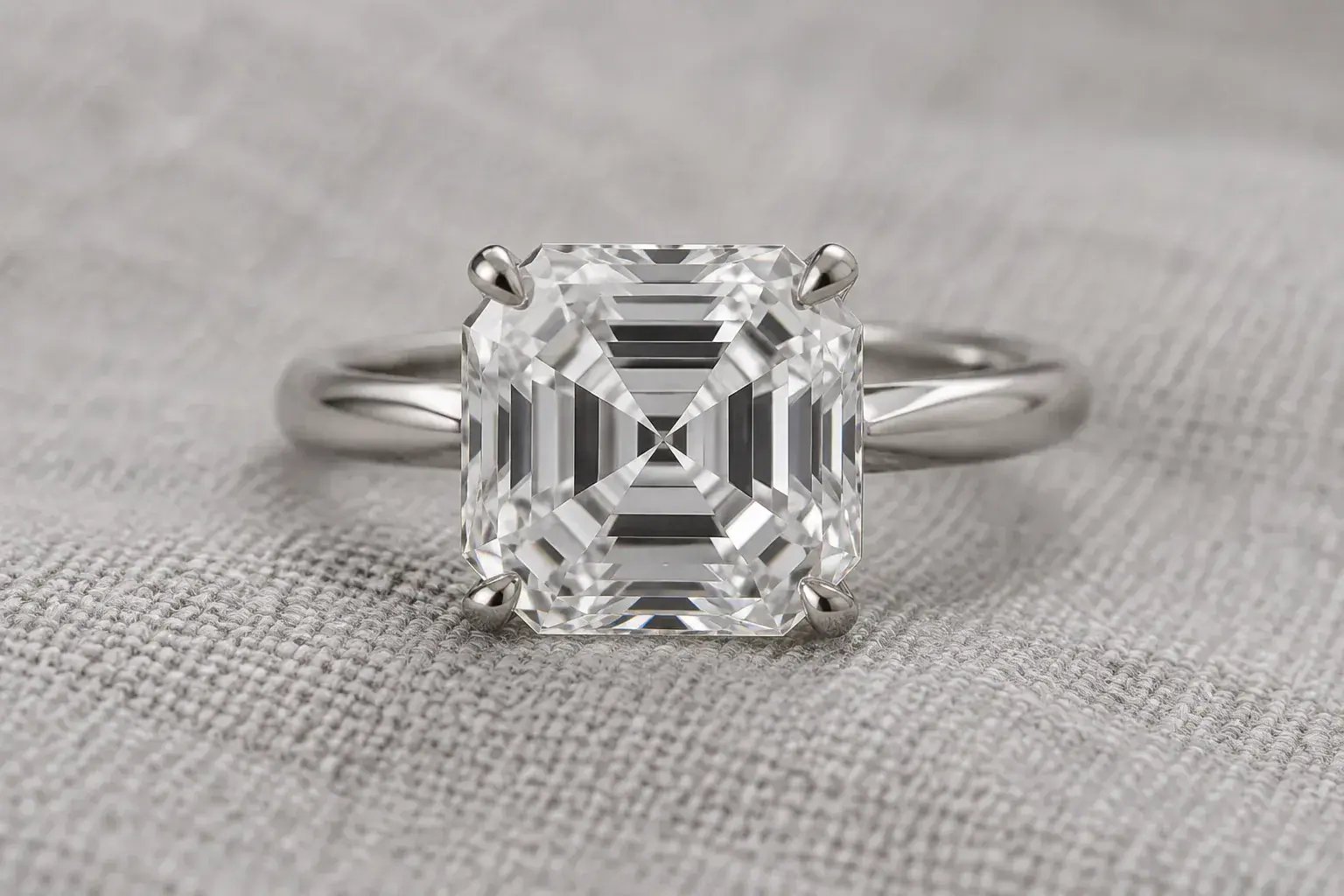
Look into a well-cut Asscher diamond and it seems to fold in on itself: square inside square, each one a little smaller, like a corridor of mirrors leading to the center. It is a quieter kind of sparkle than a round brilliant, and once you notice it, you start seeing it in every Art Deco ring you pass.
This explainer covers what an Asscher cut diamond is, where it came from, how it differs from the Royal Asscher cut and from emerald and cushion cuts, and what to check before you buy one. It is timely: in October 2026 the Asscher family's cuts arrived in a new collection at a major US retailer, putting the shape back in the spotlight.
The short answer.
An Asscher cut is a square step cut with cut corners, introduced in 1902 by Joseph Asscher in Amsterdam. It trades the bright, scattered sparkle of a round diamond for broad flashes of light and a mirrored pattern. Because its large, open facets show more of what is inside the stone, clarity and color matter more than usual.
1902
Year Joseph Asscher introduced the Asscher cut, the first patented diamond cut
58
Facets on the original Asscher cut
74
Facets on the Royal Asscher cut, reintroduced in 2001
1.00 to 1.05
Typical length-to-width ratio of an Asscher cut
01 / The definition
What is an Asscher cut diamond?
An Asscher cut diamond is a square diamond with cropped corners, cut in the step style. A step cut is a cut whose facets are four-sided, with upper and lower edges nearly parallel, like steps. Seen from above, the cropped corners make the outline an octagon, and the facets form concentric squares.
Two more details define the look: a small table, the flat facet on top, and a high crown, the upper part of the stone. Together they give the Asscher depth and the effect many jewelers call a hall of mirrors. In a well-cut stone, the reflections form a symmetrical X or windmill pattern that points to the center.
Our take
I think of the Asscher as the most architectural diamond shape. It does not flash at you from across the room the way a round does. It rewards a closer look, which is exactly why it suits people who like their jewelry a little understated.
02 / The history
Where did the Asscher cut come from?
The Asscher cut comes from the Asscher family of diamond cutters in Amsterdam. The company was founded in 1854, and in 1902 Joseph Asscher designed the square step cut that carries the family name. Royal Asscher describes it as the world's first patented diamond cut, and it became especially popular in the 1920s and 1930s, the Art Deco years.
The family is also tied to one of the most famous diamonds ever found. The Cullinan, about 3,106 carats in the rough, was found in South Africa in 1905. As Britannica's history of the Cullinan diamond records, I.J. Asscher and Company of Amsterdam began cutting it in 1908, producing nine large stones and about 100 smaller ones. The largest, Cullinan I at 530.2 carats, is set in the British Sovereign's Sceptre.
Square inside square, each a little smaller: the Asscher is a corridor of mirrors.
03 / Two versions
What is the difference between an Asscher and a Royal Asscher cut?
The Royal Asscher cut is a trademarked update of the original design, cut only by the Asscher company. The original Asscher cut has 58 facets. The Royal Asscher cut, reintroduced in 2001, has 74 facets and a higher crown. The extra 16 facets sit on the pavilion, the lower part of the stone, as Royal Asscher's comparison of the two cuts explains.
GIA, the Gemological Institute of America, traces the redesign to Edward Asscher, who added the extra pavilion facets after attending a GIA symposium in 1999. In GIA's story of the Asscher cut and its reinvention, the original 58-facet design has three rows of facets on the crown and three on the pavilion. Any cutter can make a generic Asscher-style stone; only the company can sell a Royal Asscher cut.
In the news: the Asscher cuts reach Blue Nile
In October 2026, Blue Nile launched Six by Royal Asscher, a 14-piece natural diamond collection built around six Royal Asscher cuts. Center stones run from 1 to 5 carats and prices from about $8,600 to $49,000, according to National Jeweler's report on the Blue Nile and Royal Asscher launch. Blue Nile holds the exclusive North American rights to sell Royal Asscher pieces.
04 / The comparison
Asscher vs emerald vs cushion: how do they compare?
The Asscher cut is a square step cut, the emerald cut is a rectangular step cut, and the cushion cut is a square or rectangle with rounded corners and brilliant facets. The Asscher and emerald share the mirrored, open look; the cushion is closer to a round diamond in sparkle.
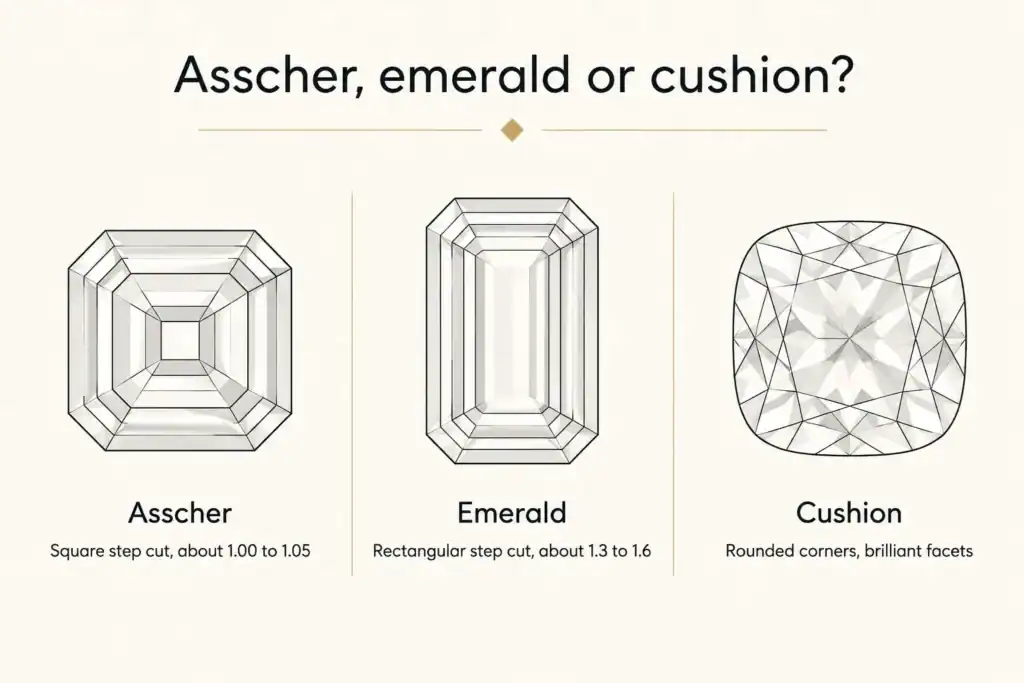
| Asscher | Emerald | Cushion | |
|---|---|---|---|
| Outline | Square, cropped corners (octagon) | Rectangle, cropped corners | Square or rectangle, rounded corners |
| Facet style | Step cut | Step cut | Brilliant |
| Typical ratio | About 1.00 to 1.05 | About 1.3 to 1.6 | Varies widely |
| Look | Hall of mirrors, windmill pattern | Long, calm flashes of light | Soft, lively sparkle and fire |
| Shows inclusions | More easily | More easily | Less easily |
| Feels | Art Deco, geometric | Classic, elongating on the finger | Romantic, vintage |
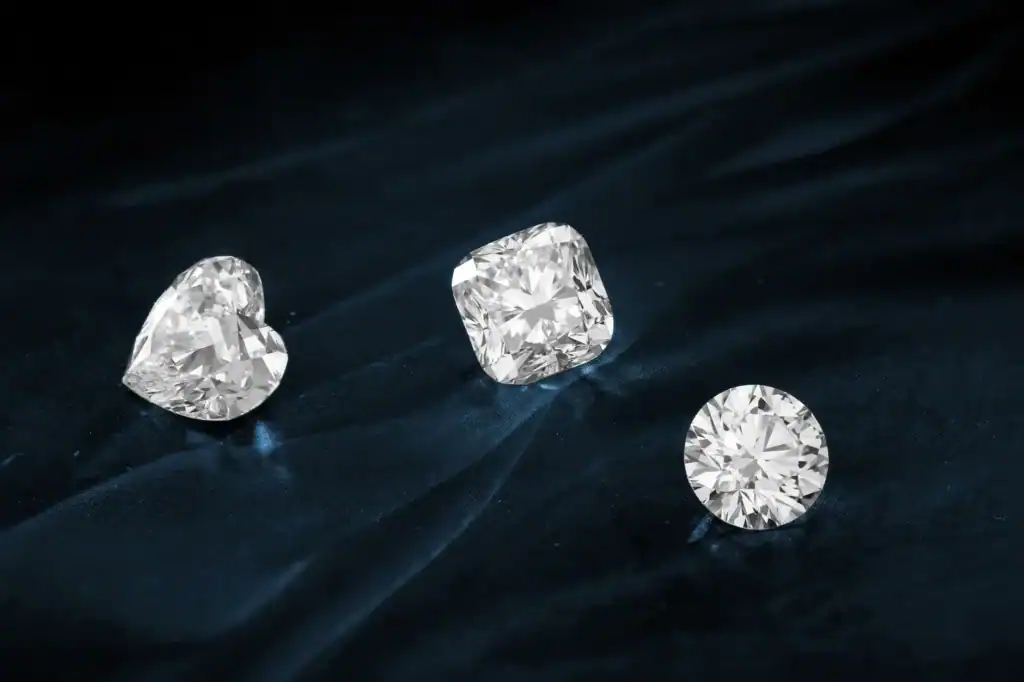
The ratio is the length of the stone divided by its width. Sellers usually treat 1.00 to 1.05 as square for an Asscher, while emerald cut ratios vary more, and sources disagree on the ideal. The cushion in the photo below shows the rounded corners and brilliant facets that set it apart from a step cut.
05 / Before you buy
What should you check before buying an Asscher cut diamond?
Before buying an Asscher cut diamond, check clarity, color, polish and symmetry, the length-to-width ratio and the windmill pattern. GIA suggests VS2 clarity or higher and G color or better for Asscher cuts, particularly above 2 to 3 carats, because step cuts show inclusions and body color more readily than brilliant cuts.
- Clarity: VS2 or higher, or a lower grade only if you have seen the stone and nothing is visible.
- Color: G or better if you want a bright white look, especially in platinum or white gold.
- Polish and symmetry: GIA gives no overall cut grade to fancy shapes, so look for Excellent or Very Good polish and symmetry on the report.
- Ratio: about 1.00 to 1.05 for a square look. Check the measurements on the report: length divided by width.
- The windmill: in photos or video, the X pattern should be even and meet in the center, not lean to one side.
- The report wording: lab reports often describe the shape as a square emerald or cut-cornered square step cut rather than using the word Asscher. Ask the seller if you are unsure.
Setting choice matters too. The Asscher cut is often set in four prongs that hold the corners, or in a halo or three-stone design that suits its Art Deco feel. If your skin reacts to some metals, compare platinum and gold settings first with our guide to safe metals for sensitive skin.
Our take
My advice: never buy an Asscher from a single photo. Ask for a video, turn it slowly, and look for that even windmill. Two stones with the same grades can look completely different, and with this cut the pattern is the whole point.
If the ring is a holiday gift or proposal, order early. Sizing and setting take time, and the busiest weeks are close. Our guide to the 2026 holiday shopping dates lays out the lead times and shipping cutoffs.
06 / Who it suits
Who is the Asscher cut for?
The Asscher cut suits people who like clean geometry, vintage and Art Deco jewelry, or a stone that looks different from a classic round. It reads as strong and graphic in a solitaire, and softer in a halo.
- Choose it if you love Art Deco design, prefer broad flashes of light to glitter, and want a shape that looks timeless rather than trendy.
- Think twice if maximum sparkle is your priority, or your budget forces a low clarity grade. A cushion or round may suit you better.
- Lab-grown or natural: the shape is cut in both. The same clarity, color and symmetry checks apply either way.
Our take
I would skip a large Asscher with low clarity to save money. With this cut you see straight into the stone, so a smaller, cleaner diamond will look better than a bigger, included one.
Frequently asked questions.
What is an Asscher cut diamond?
An Asscher cut diamond is a square step cut with cropped corners, a small table and a high crown. Its facets are arranged in concentric squares, which creates a mirrored, windmill-like pattern. Joseph Asscher of Amsterdam introduced it in 1902.
How many facets does an Asscher cut have?
The original Asscher cut has 58 facets. The Royal Asscher cut, reintroduced by the Asscher company in 2001, has 74 facets, including 16 extra facets on the pavilion and a higher crown.
What is the difference between an Asscher and an emerald cut?
Both are step cuts with cropped corners. The Asscher cut is square, with a length-to-width ratio of about 1.00 to 1.05, while the emerald cut is rectangular, usually about 1.3 to 1.6. The Asscher looks more geometric and inward-turning; the emerald looks long and elegant.
Is an Asscher cut the same as a cushion cut?
No. An Asscher cut has straight-cut corners and long, open step facets. A cushion cut has softly rounded corners and many small brilliant facets, so it shows more sparkle and fire but less of the mirrored effect.
What clarity and color should an Asscher cut diamond have?
GIA suggests VS2 clarity or higher and G color or better for Asscher cuts, especially above 2 to 3 carats. The open step facets show inclusions and body color more easily than brilliant cuts do.
Does GIA give Asscher cut diamonds a cut grade?
No. GIA gives an overall cut grade only to standard round brilliants. For fancy shapes like the Asscher, the report lists the shape and cutting style, measurements, and polish and symmetry grades, so those are the details to check.
The takeaway
An Asscher cut diamond is a square step cut with cropped corners, born in Amsterdam in 1902 and loved in the Art Deco era. Its charm is the mirrored windmill, not glitter, so buy for clarity, color, even symmetry and a square ratio, and always judge the stone on video before you commit.